Wednesday, October 26, 2016

Semliki - the Kirumya Trail

It's been a couple months since that fateful day in Semliki National Park whenst two companions were drawn apart by the mysterious and sinister influence of a certain swallow. Time has flown by, and with it, a healing process begun. Sitting in my room this half-term, still financially crippled from this very adventure, I've had a lot of time to kill. So, hoping to not aggravate my old companion (whom I hold so dear), I will now unleash some of the pics from that 28 km epic bird hike along the Kirumya Trail.

The uber-shy Red-billed Dwarf Hornbill, which we had chased around vainly at the hotsprings, reappeared on this magical trail. They afford 1 good view and if you miss that view then you won't find another one for at least 24 hours. I can't even imagine trying to find this bird ourselves without the help of Justice's whistles and calls on his phone. We did. The rest of the morning comprised of marching at a determined pace, punctuated by abrupt stops when Justice heard an interesting bird. The man's senses are razor sharp.

We were baffled and surprised to hear a story of the park almost losing him to some random nowhere park (the exact details of which it is not my place to share), but in the end, a bizarre intervention prevented his unholy exodus from taking place, and he continues to be one of the word's best local guides to one of the toughest birding locales. Thank God, because without Justice, we would have been hopeless.


After what seemed like endless walking or 'mud peddling' as Justice called it, when it seemed like the trail got worse and worse and I was starting to guess when we'd have to turn around, I spotted a body of water. I thought it was a lake but actually, this was the Semliki River itself. I was not expecting it to be so wide. I quickly scanned the horizon for the characteristic poles which the fishermen use to string their nets to. Justice said that on this segment, the swallows always use these poles as perches while hunting for insects over the water. There were many, all vacant of metallic blue tops. I told myself to be patient and while Justice chatted up the local fishermen, I scanned until I spotted two ducks squabbling far on the Congolese side. Hold on a sec', those aren't ducks...those are Finfoots! The African Finfoot, one of my great nemeses, just appeared out of nowhere. But as soon as I raised my sniper lens, they had gone into the reeds. The finfoot is an extremely shy bird.

Later, I did spot two swallows, far, far over the water. This called for a special boat charter, which set me back approximately 1 US dollar (Justice and I each had our own boat). I felt like a British explorer being taken into the jungle with my expensive gear and this fisherman prodding me gondola-style in an actual hollowed-out log canoe. "Man, I wish Martha were here" I thought.

The vessel of choice
 Around the bend of the river, we found 7 White-throated Blue Swallows congregating on some dead branches hanging over the water, exactly as described in the book.

White-throated Blue Swallow
I had my boatman gently prod us forward until the last swallow took off, then went to check on the finfoots. They were long gone, but the search did reveal a group of Orange Weavers, apparently not known to occur at this site although the book says they've been recorded along the Semliki River at some point. 

Chestnut-capped Flycatchers

As the day got later, the temperature got hotter, the birds quieter and our pace quicker. But this was one of those long hikes where the suffering pays off. Crossing the swamp again, I knew we only had another 6 km to go. 

Very carefully...one step on a thorn or spike and I could get a jungle infection
This picture of me crossing the swamp pretty much sums up the Semliki experience. My expression is a combination of triumph and pride mixed with a feeling of deep guilt and shame for abandoning my friend. In my eye, a flicker of incensed rage. 

Justice told me many stories of people he's taken around Semliki. Pretty much all of end with people yelling at each other, yelling at him, going mad, going broke, or preparing for divorce. Yes, this forest certainly has an intoxicating effect on those foolish enough to enter it. In the case of Martha and I, our friendship survived, and is now stronger than ever. Perhaps one day we can return, conquer the swamp and see the blue swallow together. 

Sunday, September 25, 2016

Baringo - Quest for the White-crested Turaco

If this trip had a theme, it would be "not holding back." 

I had 3 days between our triumphant return from the epic Samburu-Meru-Mt Kenya-Mukuruwe-ini expedition, it was just barely enough time to insert a quick trip to Baringo with the legendary Wilson Tiren. 

Wilson is just about as epic a character as Baringo itself. Growing up beside the "big brown lake," Wilson knows every single bird and every character in down. This includes all the cute girls obviously. 


Chillin' at the "choma zone"
I met Wilson in nearby Bogoria where we did whatever any Kenyan does before doing anything worth doing - drank some chai. After enjoying our traditional refreshment, Wilson told me to wait while he arranged transportation. Seconds later he pulled up on a sweet new motorbike. Apparently it was at our disposal for the entire weekend, for a price to be determined upon return. "It won't be alot" he assured.

Baringo high street
Our first of two mornings called for an amphibious assault. We would charter a boat on the lake for Allen's Gallinule, Saddle-billed Stork and Madagascar Bee-eater et al., then while the morning was still young (hopefully), we'd rip up into the hills for the stunning White-crested Turaco.

The boat ride failed to yield my nemesis the Saddle-bill, but did compensate with an epic sunrise decorated with African Darter silhouettes. We turned up the Bee-eater and the Gallinule, along with a bonus Greater Flamingo fly-over and the usual suspects (bellow).

African Darter and Great Cormorant
Goliath Heron
Madagascar Bee-eaters
Northern Masked Weavers
Senegal Thick-knee
Birds everywhere, we were mesmerized. Then I checked my watch. Crap! We'd gone past the 2 hour mark on our boat ride. Although Willy had gotten us a discount (2000 per hour instead of 3000), 6,000 bob was still a hefty blow to my Baringo budget. I ended up having to mPESA the guy the money when I got back to Nairobi...woops.

Not only had our little boat ride taken me overboard on the budget, but the morning was pretty much spent. This meant we'd be hard-pressed finding the White-crested Turaco, which was almost an hour's ride up into the hills. That did not stop us from buying a couple of fish from a dude in a little bamboo punt and feeding them to the Fish Eagles (finally I know how people get those awesome pics of them swooping down on fish!). Mine were blurry.

African Fish Eagle 
We hustled up to Kipcherere, a tiny hamlet up in the hills inhabited by Kalenjin folks. Always curious to see a mzungu, they were eager to offer us some advice. Some old-timers emphasized how hard-pressed we'd be this late in the morning, but bragged that they had seen "a whole bunch" earlier in the morning. Defying these nay-sayers, we started up into the hills by way of a stream. The forest was lush and full of birds and butterflies, but no White-crested Turaco. We returned to the village empty-handed. The old-timers were still there sipping chai, eager to confirm that we would not have seen any this late in the morning. But they clearly did not know Wilson Tiren fully. He has never missed them with any of his clients and was determined not to spoil his perfect record! 
Martha ID tafadhali
The town of Kipchere feels like the middle of nowhere
Chestnut-crowned Sparrow-weaver
An old lady was saying something to us in Kalenjin. Wilson's translation sounded like "give me 50 bob to make you some chai." I said ok, duly handing her the 50 shilling note. It turned out she was saying "give me 50 bob so I can have some chai." Our afternoon refreshment budget spent, we decided we might as well head back out there for round two. 

Not long after, we heard two Turacos calling up another hill! To make a long story shorter, we bush-whacked until we tracked it down. Wilson strategically startled it up right in front of me for a PERFECT view. What a STUNNER! Only too bad all I managed was a shot was this one bellow. Evidently the key field mark is obscured...
White-crested you-know-it
That night we celebrated our victory with a well-earned beer and nyama choma. This local joint was tended by a friend of Wilson's (who happened to also be a cute girl), who apparently had no problems with him manning the bar while she cooked us up some nyama choma in the kitchen. Several customers came in while he served their various drinks and collected the money in the cash box which he seemed to already know the location of. 

The second morning consisted of rounding up as many Baringo birds as possible along the lake shore and cliffs. A couple Verreaux's Eagle Owls were hooting their super-creepy hoot all morning, their version of romance, while bristle-crowned starlings frolicked on the lawn. Love was in the air.

Bristle-crowned Starlings
Verreaux's Eagle-owl
Verreaux's at the height of breeding season
African Scops Owl
Jackson's Hornbill
One last trip to the cliffs was still in order, not because we wanted to, but because we had to. We were birders, after all, and I didn't come all this way to sip chai and look at cute girls. When else am I gonna get another chance to see a Familiar Chat, anyway? So, despite being knackered, we worked the cliff until our time was up, because I had to get to Nairobi before dark (note this mom, I am very safety-conscious when I travel). We came up empty handed, but as we started to drive away, I twisted my body around for one last scan, and, spotting a small brown passerine lifting its tail atop a shrub. Stop! I said. I raised my binoculars. It was a Familiar Chat! Now we could leave, knowing we'd lived life to the fullest.
Familiar Chat

Tuesday, August 23, 2016

Rwenzori

We awoke at 3 am. The much anticipated day, what we had all payed big money for, and some trained for, the trip to the summit of the Rwenzoris: 5,109 m Margherita Peak. I had prepared my body and mind for this physical challenge for months - nothing could spoil it.

One of the classic characters on our team was Tom. Currently reading the complete works of Shakespeare on his Kindle, Tom seemed to have incredible mental endurance. Despite not having trained in any particular way for this climb, his tenacity and sheer zest for mountain glory proved sufficient for the campaign.

"Want some sunscreen?" asked out guide. "No thanks, I like to live dangerously" replied Tom. "You like to have a red face?" I asked. Banter aside, things were about to get real as we got up to the glacier.

We started climbing with headlamps at precisely 4 am, hoping to reach the summit after 5 strenuous hours of steep climbing and roped glacier travel. Five days of approach had gotten us well-acclimatized for this as our bone marrow trickled out a few extra red blood cells with each day. After summiting, we would start the descent to base camp, then another 5 km or so to the next camp from 5,109 m to about 4,000 m or so. We carried on, my group taking the lead. In behind, a young swiss/NZ couple who seemed to know a thing or two about mountaineering and bringing up the rear, a Swiss father and son team, led by Vulcer who is 72 years old. He would be the 3rd oldest person to reach Margherita Peak.
A typical segment of the trail
A White-necked Raven presides over the camp

White-necked Raven, our familiar companion

Swiss father and son begin ascending the second glacier

Getting suited up

This trek is known to be significantly more challenging than Mt. Kilimanjaro and Mt. Kenya (Africa's 2 highest mountains), despite Mt. Stanley only receiving a few hundred visitors each year. Still, hike participants in general agreed that this was much harder than they expected. With no turning back, maintaining positivity and morale was our best weapon.

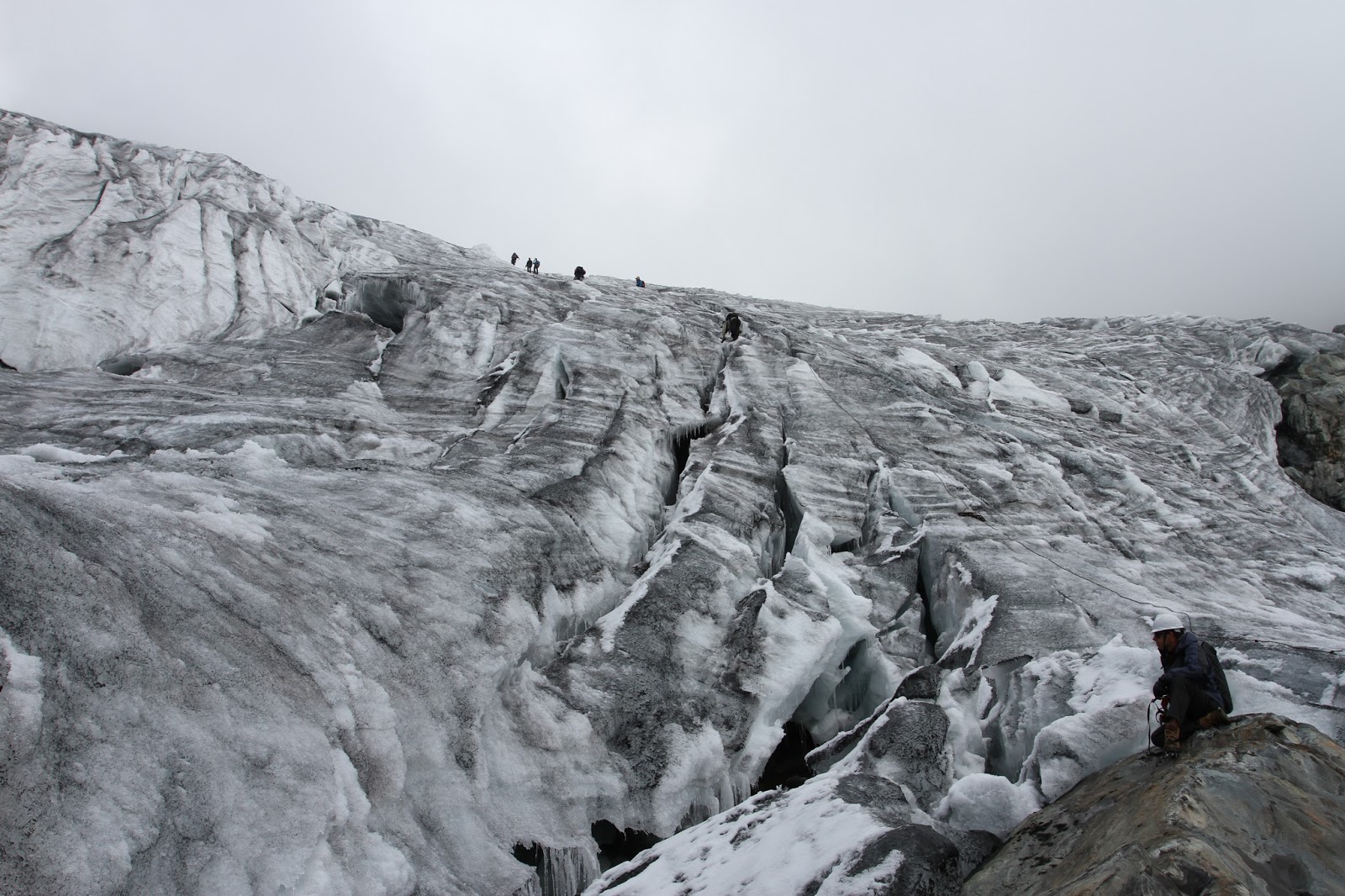
We came to our second glacier, a very steep one at 4,900 m where the air gets a little thin. Myself, having only traversed my first glacier 30 minutes earlier, was no veteran but I was relishing my first experience, getting right into the techniques. "This is one of the best days of my life!" I yelled.
To give you an idea...
First, our guide, then Tom, then me, our fate connected by one rope. I have to admit I was a little nervous. After only 2m of roped travel on the steepest section of glacier, Tom's crampon came off resulting in a brief hair-raising moment before Richard swooped down to jimmy-tie his crampon with a shoe lace and save the day.

I expressed my concerns to our guide but he reassured me in very African style, and we were at it again. In moments such as these, one must simply say TIA and get on with it. I thought about he fine print of my insurance where it says something about not covering mountaineering...

Anyway, we made it, behind us, the NZ/Swiss couple were discussing technique with their own guide. "Moses, this is too much rope between us, what if you were to fall?" It's ok, I'm not going to fall" replied Moses somewhat cockily. "Not even the best mountaineer says that" yelled John. I have to say, I did laugh but at the same time but it added a little hairiness to the whole vibe of the glacier traverse/climb. From what I gather, the glacier travel was pretty straightforward traditionally, but higher temperatures/climate change have caused rapid melting, resulting in all sorts of new crevasses and rapidly heating/cooling snow that becomes quite crusty and difficult to penetrate with an axe. Sadly, in some years from now there will be no more glaciers on the Rwenzoris.

The summit came into sight, I requested my guide's permission to be "unleashed" (hehe), and I bolted the last 100m to the top. I was a true king on that day. My concerns for our imminent death disappeared as I basked in the glory of the alpine sun and the clouds cleared to herald our arrival at this legendary summit.

Typical altimontane vegetation with Giant Lobelias

Lord-of-the-Rings-epic

Above the clouds
"One of the best days of my life"


The descent - note the large crevasses created by the rapid melting of the glacier

The way back started with a haemoglobin-induced high during which I ran a couple of kilometers through boggy terrain, stopping only to photograph the occasional Scarlet-tufted Malachite or Rwenzori Sunbird.

Scarlet-tufted Malachite Sunbird
Rwenzori Double-collared Sunbird

The following day, however, the mileage had caught up with my legs. On the second-last day, I did something I'd sworn against: asked the guide how much longer we had left! It turned out, only a km, making my request a wasted one. We reached our target camp shattered. Huddling around some chocolate bars and sheltering ourselves from the rain, we discussed strategy (stay the night or press on). Again, surprisingly, I think I was the only person to vote stay! Yes, this physical challenge truly was putting me to the test. We trudged on in our wellie boots, our knee menisci deteriorating with each step. 

Rwenzori Turaco - finally!!!
Fortunately, the decision to press on paid dividends in terms of birds. The next camp turned out to be in optimal habitat/elevation for the Rwenzori Turaco, the most awesome Rwenzori bird which had eluded us for 7 days. It took a lot of patience and required sacrificing breakfast but I managed to capture the beast, after waiting for 30 minutes motionless beside the tree he was calling from. What a perfect ending to an epic trek with some fantastic characters! As a bonus, one of the guides saved me a plate of scrambled eggs which may as well have been served at the finest Michelin-starred restaurant. Hunger is truly the best seasoning, as they say. 

Semuliki


One Canadian science teacher. One Kenyan tour guide. The first, a canuck-turned-London man, is a neurotic, over-rushed maniac with a bipolar nature of being at times a well-rounded gentleman and at others, an obsessive-compulsive twitcher with sudden urges to wrangle reptiles. The other is a calm, collected and wise woman who takes her time to enjoy nature and with a matriarch-type personality.


These two haphazard companions were brought to southeastern Uganda for a single divine purpose: to slay the Albertine Rift endemics (and maybe photograph a few butterflies and even have a little fun by accident). At odds with this later objective was a dark and sinister force: the wrath of forest birding, whereby birds are like ghosts - more often heard and seldom affording even a second's view, ever keeping to the shadows of the thick undergrowth or up high in the canopy. Luckily, in Semuliki forest, we had Justice on our side (literally, our guide's name was Justice). That is so African, we thought, spurring a small brainstorming session for what I might name my first kid. Some kind of name, I thought, that is a good virtue, like "Wisdom", "Purity", "Precious" or "Favour." But then there are the ones I would call tier 2, like "Godliness", 'Prudence", "Innocent", etc.. I could go one step further and name my kid after an even more specific virtue or good character trait. How about "Steadfastness" or "Loyalty". No, I thought, if I were an African, I'd name my son: "Stick-to-itedness Snieder".


Back to our tale. We followed Justice into the forest to some nice hot springs, nabbing an assortment of Semuliki specialities along the way. For the non-bird-savy, Semuliki a little bit of Congolese lowland tropical forest that justs into south-western Uganda. Since nobody can really go birding in the Congo, aside from in the Virungas, it is the best place to see these Congolese lowland forest species. We managed to pick up such tasty ones as Fire-crested Alethe and the aptly named Leaf-love. An evening foray failed to hear the highly coveted and mythical Nkulengu Rail, which Justice told us would be a waste of our time if they are not calling at the time. Nor were we able to get a visual on a calling Swamp-palm Bulbul. Such is the unforgiving torture of Semuliki birdng where a second's distraction could spell lifer-missing misery.


A fire-crested Alethe, one of the low-altitude specialties of Uganda


A reclusive Forest Robin offers a second's view


Rails aside, the day-time birds were not enough to satisfy my heart's desires. I asked Justice of a great  and mythical swallow that dwelleth deep in the jungle, on the Semuliki River which divides Uganda and the Congo. "What if we were to harness its power and use it to our own advantage" I thought. We discussed the possibility. I sensed hesitation and doubt in his voice at the mention of this bird. I soon knew why. It would involve a 14 km march through uncertain (most likely swampy) jungle. Justice summoned another guard to accompany Martha in case we were to split up.


A dark shadow loomed over our quest as I too shared some doubt, I am ashamed to admit. At dawn, we set out for the river. The fellowship moved at a steady pace, making strategic stops along our way, trying to opportunistically nab lifers along the way while at the same time trying to keep a quick average pace. Crested Malimbes, Brazza's Monkey and White-crested Hornbills meant we were off to a good start by any standard!


Eventually, we reached a secluded forest pool. Immediately, a Shining Blue Kingfisher scooted across the water. I peered around the far corner of the pool to behold a mystical sight: a Hartlaub's Duck making a ghostly retreat. This is the only spot in East Africa to see this reclusive jungle duck, elsewhere found in the Congo. We crossed the pond over a slippery log using poles for balance. Then, a frightening sight: swamp covering the trail as far as the eye could see. Justice and I began the crossing, him in his Wellies and I by removing my boots and wading.


But there was a problem: the girls were no longer with us. There was some confusion and yelling of stuff in the local language, then I came to understand that they were not going to go any further with us. I waited. Were they coming? I could hear Martha's voice but not understand a thing. Would we make it all the way to the river? Justice was getting impatient and entertaining the idea of turning back. I could feel the corrupting influence of the White-throated Blue Swallow taking hold. Men are weak, and it appears to hold great power over them. Alas, it is with great shame that I tell you, we carried on to the river. There were many miles of mud and swamp ahead, and Justice could only wait so long. My worst fear had been realized: I had forsaken my companion and followed my guide to the river to seek for forbidden Swallow, a true Boromir moment. The fellowship was broken.


Friday, August 5, 2016

Mt. Kenya: Quest for the African Green Ibis

In Kenya, few birds evoke more mystery than the African Green Ibis. This near-mythical forest bird has eluded me during several days spent in Aberdaires and Mt. Kenya - so we did some intel and returned to Mt. Kenya for unfinished business. Ebird led us to Castle Forest Lodge, a place fit for a king (indeed - Queen Victoria once stayed here). Mfalme approves. As you can tell, it is a true mountain paradise.


We met enthusiastic guide Joseph - I don't think I've ever met a bird guide so energetic. At 6 am your habari ya asubuhi (good morning) is met with an enthusiastic SALAMA KABISA! (extremely peaceful!). Indeed, we did feel an extreme peacefulness in the mist-enshrouded paradise. And yet, a violent fire burned in our hearts - one for the mysterious mountain ibis. In order to see this retreating species, one must intercept them to and from their roosting site, at early dawn or late evening. In between those times, we had a lot of time to kill, so we explored around the lodge, turning up some interesting findings.

Grey-headed Negrofinch

Doherty's Bush-shrike (very shy!)
Jackson's Chameleon, one of the "Jackson Five"
Tacazze Sunbird
 Surprisingly, the Ibis are very noisy birds in flight, and hearing them was not hard. Seeing them, a challenge worthy of team Mfalme. On our final evening, we waited on the porch, beer in hand, for the evening flight. There was a thick smoke from a nearby campfire ebut you can clearly see the ibis in this photo.

African Green Ibis seen from the lodge patio flying to their evening roost

Based on their trajectory that evening, we estimated where they would fly over the road and headed to that spot the next morning before dawn. Amazingly, they passed right over us, circling a couple of times and affording this shot, in which you can see the shiny cheek-patch from my built-in flash. Their silouettes were very clear through the morning mist and their calls a loud Ahhnk ahhnk. They would be the first of 3 epic-ally rare birds we would see in one day.

African Green Ibis flying from their roost

Solo Kayak Journey

One day, a lonely man got in a 1997 Solstice GT to paddle to Knight Inlet. Through persistent rain and mosquitoes, he journeyed from camp to...